

15 Apr 2026
Office pod sizing guide: which size do you actually need?
Buying guides
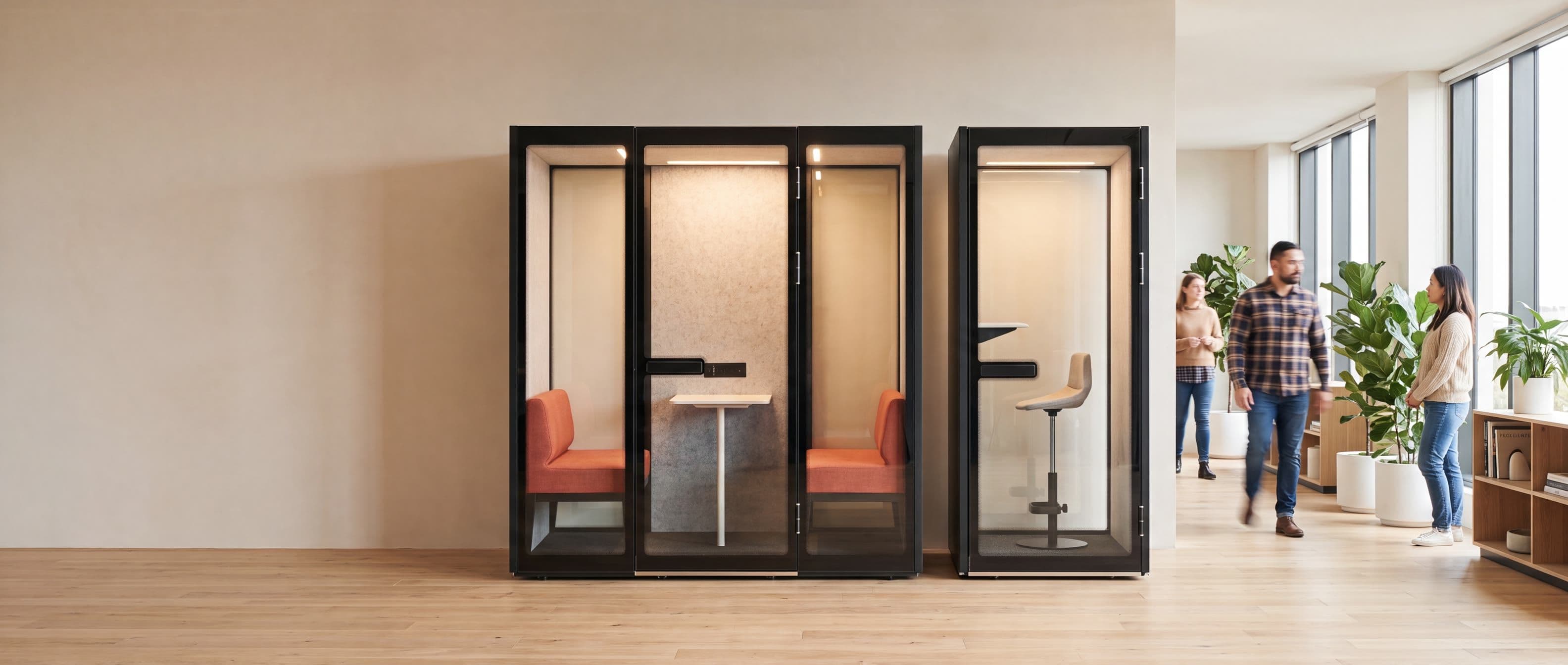
A practical guide to choosing an office pod for a workplace in New Zealand.
Choosing an office pod is a bigger decision than it first appears. Size is the part that is hardest to undo once the pod is on your floor. Acoustic figures get quoted in units that are not comparable with each other. And what sits inside the base price varies enormously from supplier to supplier.
This guide covers what to look at before you buy: how to match a pod to the way the space will actually be used, how to read an acoustic rating honestly, what to ask about ventilation, and what to check on any quote before you compare it with another one.
Start with headcount: size for the meeting you hold most weeks, then check your largest one still fits. Each meeting pod has a designed number and a stretch number (the L4-Pod is designed for four and takes six for a shorter meeting), so the right size is the one where your usual meeting sits at the designed number and your biggest fits within the stretch.
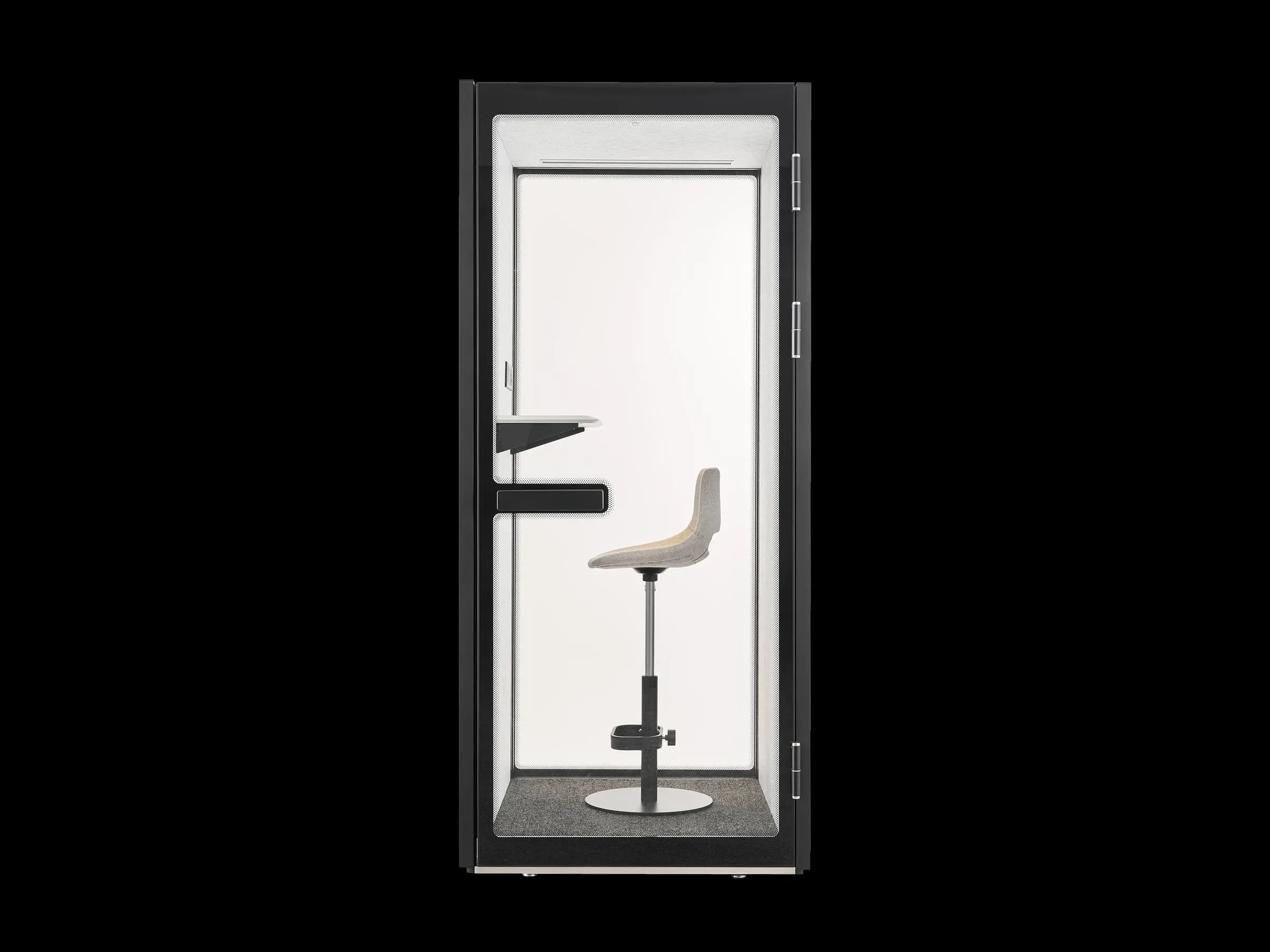
S-Pod (1 person) — Our most compact pod, 960 mm wide and 1,000 mm deep, which is roughly the footprint of a standard desk. Built for calls and short focus sessions, with a sit-stand desk and a height-adjustable stool. From $8,795 excl GST.
MW-Pod (1 person) — The same job, for longer. A larger footprint with room for a full office chair alongside a wall-mounted sit-stand desk, for people who work in the pod for hours rather than minutes. From $11,795 excl GST.
M2 (2 people) — A meeting table and two sofa chairs, set up for confidential one-on-ones, interviews and sensitive reviews. From $12,395 excl GST.
L4 (4–6 people) — Our most popular size, for team meetings and video calls. A central table with two sofas, and a display mount. From $13,895 excl GST.
XL (6–8 people) — For larger team meetings, training sessions and workshops, with a full-sized table, two sofas and a display mount. From $23,995 excl GST.
All three meeting sizes are compared side by side, with prices, on our meeting pods page.
One thing worth settling before you pick a size: if a monitor or screen is going in the pod, count it as an occupant. It takes the space a person would have used, and it needs viewing distance in front of it. Across the range the display mount starts at the L4, so in practice a screen and a size step tend to arrive together. Our office pod sizing guide goes through the range model by model if you want the detail.

Acoustic ratings are usually the first figure on the page and the hardest one to compare. Different standards measure different things, and plenty of published numbers are manufacturer-stated rather than independently tested — so two pods quoting similar figures may not have been measured the same way, or measured at all.
The Peacepod S-Pod was independently tested by SGS to ISO 23351-1 and certified Class A, with 30.1 dB of speech level reduction.
ISO 23351-1 is the international standard for measuring speech level reduction in enclosures such as office pods and booths. It measures how much the pod reduces the level of speech passing out of it — which is the thing you actually care about in an open-plan office.
So when you are comparing pods, the useful question is not whose number is highest. It is who can show you a third-party test certificate, which standard it was tested to, and which model it covers. A figure with no certificate behind it — or a certificate for a different model in the same range — tells you very little about the pod you are being quoted.

A sealed acoustic pod has to move air, and ventilation is easy to skip past while you are comparing sizes and prices. A pod that feels stuffy after half an hour often gets described as claustrophobic, when the real problem is airflow.
Every Peacepod has continuous ventilation as standard, on a variable-speed system you control from the panel inside the pod — the same panel that dims the lighting. The fan count scales with the size of the pod: four fans in the S-Pod, MW-Pod and M2, eight in the L4, sixteen in the XL. A bigger pod runs more fans rather than faster ones. The ducts are internally baffled, so the ventilation path does not become a sound bridge between the inside of the pod and the office around it.
Lighting and ventilation switch on as someone steps in and switch off after they leave, handled by a proximity sensor in the ceiling. Nobody has to remember to turn anything on, and nothing is left running in an empty pod.
Fan count is the specification worth pressing on, because most ventilation claims are adjectives — quiet, efficient, high-volume — and adjectives cannot be compared across two quotes. A number can. So ask how many fans a pod has, whether ventilation is included or an optional extra, what switches it on, and whether it is quiet enough not to carry on a call. Ours run four, eight or sixteen depending on the model, and we would encourage you to put the same question to anyone else you are considering. Our ventilation page sets out how the system works, fan by fan.

What sits inside the base price varies a lot between suppliers. Furniture, lighting, power and the acoustic fit-out are standard on some pods and separate line items on others, so two quotes for the same-size pod can describe quite different objects. Get the inclusions in writing before you compare the numbers.
Every Peacepod includes as standard: the furniture appropriate to the model — a sit-stand desk and a height-adjustable stool in the S-Pod, a sit-stand desk and a full office chair in the MW-Pod, a meeting table with sofa chairs in the M2 and with sofas in the L4 and XL; motion-activated dimmable LED lighting; continuous ventilation; a power socket with USB-A and USB-C; smooth-rolling casters, so the pod can be moved when the floor plan changes; and acoustic felt interior panels with acoustic glazing.
There is a short options list, and it is worth asking any supplier for theirs: a solid rear wall in place of glass, smart glass, privacy film, an extra socket, a network port, an air-conditioning penetration, and custom colours on small runs. Most workplaces never add any of them. Installation is quoted separately from the pod, so check how each supplier handles that before you compare two prices.

Peacepods are assembled on site. The panels come in through the building's ordinary doors and lifts and the pod is built in position, so there is never a finished box to manoeuvre through a corridor or squeeze into a lift. That is what makes upper floors and older buildings straightforward.
The pods are heavier than they look — 328 kg for the S-Pod, 512 kg for the MW-Pod, 503 kg for the M2, 599 kg for the L4 and 785 kg for the XL. Mass is a large part of how a pod blocks sound, and it costs you nothing in flexibility: every model sits on smooth-rolling casters, so two people can reposition one when the layout changes.
Lead times depend on stock, and we hold most models in stock — so delivery is usually one to two weeks. If a pod does need to be manufactured, allow around eight weeks, and that applies to custom pods too.
The best way to choose is to sit in one with the door shut, make a call, and get a real sense of how the acoustics, the ventilation and the space work together. Try one at our Auckland and Christchurch showrooms. Our showrooms page has the details, and our comparison page puts every model's specifications side by side.
About the author

Rob Berman
Founder & CEO
Rob founded Peacepod in 2020 after one too many afternoons balancing a laptop on his knees in an office reception. Built to sell direct from the manufacturer, Peacepod was designed to make open-plan offices actually work for the people using them.
Tell us the room and how it gets used, and we'll come back with the models that actually suit — not the biggest one.